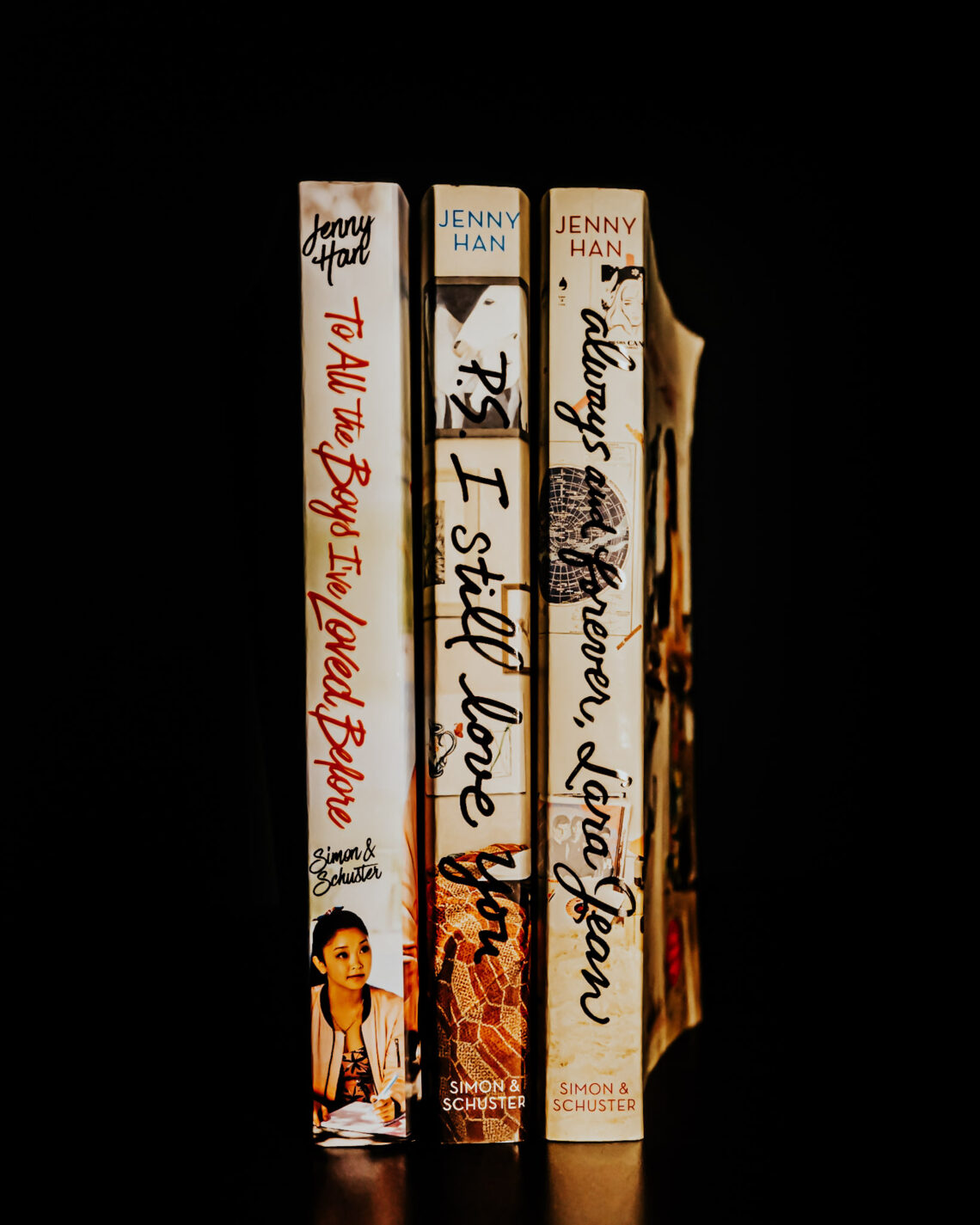
To All the Boys I’ve Loved Before Book Review: Love Letters in the Teal Hatbox
“I like to save things. Not important things like whales or people or the environment. Silly things. Porcelain bells, the kind you get at souvenir shops. Cookie cutters you’ll never use, because who needs a cookie in the shape of a foot? Ribbons for my hair. Love letters. Of all the things I save, I guess you could say my love letters are my most prized possession. I keep my letters in a teal hatbox my mother bought me from a vintage store downtown” – Prologue to To All the Boys I’ve Loved Before.
The premise of YA romance novel To All the Boys I’ve Loved Before written by Jenny Han follows Lara Jean and her romantic relationship with Peter Kavinsky and familial relationships with her younger sister Kitty, older sister Margo, and her father. Lara Jean’s mother passed away six years ago, and her father is left to raise them, but since he works at the hospital, Margo steps up into the role of the mother. Spoiler Alert: Kitty mails all of Lara Jean’s old love letters (from middle school) to each of the boys addressed in the letters, which eventually sparks the relationship between Lara Jean and Peter. Lara Jean and Peter engage in a “fake relationship” for different reasons, but eventually, their feelings surface and grow into love. Originally, I’d only watched all three Netflix films of the To All the Boys I’ve Loved Before series, so I was curious about the books. I absolutely love watching and reading romantic comedies; I appreciate all the cliches and familiar tropes but also the plot twists. I thoroughly enjoyed tracking the changes between the film and the book. The film definitely has on rose-colored lenses over the familial and romantic relationships, and I found the book more genuine and rawer. I almost don’t feel that it’s right to compare the books and films because they are vastly different—in regards to the plot, setting, and characters. The book depicts more of Margo’s love for her family but also the intense pressure that she faces: “You know what Mommy would always say to me? … ‘Take care of your sisters.’ So that’s what I did. I’ve always tried to put you and Kitty first. Do you have any idea how hard it was being so far away from you guys? How lonely it was? All I wanted to do was come back home, but I couldn’t, because I have to be strong” (346). I thought the film didn’t capture the weight of Margo’s influence over the family enough. Moreover, the strain, tension, and growing up too fast rings through in a compelling fashion. But that is why, I always tend to enjoy books more than the film. Films market and cater towards a certain audience, so moments in the text get lost in translation.
I also loved the employment of love letters; it’s very Regency and Victorian Era-esque. As a person who loves writing love letters and poems, I was happy while reading. I’m currently taking a 19th Century British Novel course where I learned about cross-writing (writing from left to right, up and down, and sometimes diagonally across the page, all on the same letter! It was a way to save paper). In that same course, I recently researched and presented on the Victorian valentine, where people hand wrote poems of rhyming couplets to their loved ones. Lara Jean’s letters parallel the valentine because she expresses her love for each beloved. It’s also incredible how letters move the plot along in Han’s novel.
Lara Jean is a romantic; she loves the idea of love. Scholar Janice Radway unpacks Catherine Kirkland’s study of the Romance Writers of America with the reasons why readers of romance turn to writing: “to intensify the fantasy experience they associated with the act of romance reading. Others, however, did so out of newfound confidence, which they attributed to romance reading, and which led to a desire to provide pleasure for other women” (17). Connecting it back to Han’s text, I would also argue that writing love letters is a form of romance writing and a trope in romance texts. Lara Jean reads romance novels, watches Romantic Comedy films, and writes many love letters to her crushes throughout the years. Writing is therapeutic and gives her a sense of closure when she writes letters. As for the “fantasy experience,” Lara Jane, in writing the letters, immerses herself in a fantasy, another universe, where she can be brave to share her feelings, something she wouldn’t do in person at the time.
As a reader of romance novels, I do appreciate how contemporary texts portray desire and love without the shame. While reading, I found myself relating to Lara Jean’s character in her love of romance. Part of the reason why I wanted to create this literary blog was to also experiment and sprinkle in romance writing in the form of poems, memoir, and book reviews. I’ve always been drawn to the romance genre because there’s something special in rooting for your favorite characters to end up together but also in witnessing how different people love. I love seeing the development of love, whether it’s from the enemies-to-lovers, the friends-to-lovers trope, and more.
While reading, I also tracked how race is portrayed in the novel. Lara Jean is biracial: her mother, Eve Song, was Korean and her father, Dan Covey, is white. Lara Jean and her older sister, Margo, are described to look “more Song than Covey,” while her younger sister, Kitty, looks more like their father (9). After her mother’s death, Lara Jean wonders if she would have known more about her Korean family or how things would have been: “I’m always wondering about the what-ifs, about the road not taken” (11). Lara Jean’s father does try to cook Korean food to keep the memory of her mother alive, and the family spend time with their Korean relatives. She celebrates both Korean and American holidays. However, at school, despite being biracial, she faces Asian stereotypes. In a conversation with Peter about Halloween costumes, Peter asks if Lara Jean could be Mary Jane in a red wig, but Lara Jean responds with: “No, I could not. You know why? Because I’m Asian, and people will just think I’m in a manga costume” (230). Peter—being a white male—doesn’t understand the stereotypes that Asian Americans face and how they are seen as foreign, not an American.
Scholar Pamela Thoma provides a term for understanding Lara Jean’s experience with exclusion. She explains cultural citizenship in terms of the historical exclusion of immigrants in the 1990s with the “new nativism” movement where they gave “partial citizenship, or [excluded] immigrants from belonging all together” (25). Thoma reflects on the motivation of the movement as “the perception that transnational immigrants posed threats to cultural assumptions about what it means to be American” (25). The remnants of the movement continue today when white people exclude people of color or refuse to accept the differences in cultures and the wide possibilities of it means to be American. The assumption that she is a Manga character instead of Mary Jane from Super-Man can be read as others upholding the binary of being white, synonymous with being an American in this case, and being a person of color. Lara Jean is judged based on her appearance as a Korean person as being shy and a rule follower. Despite being biracial, others only see her as being the “invisible” Asian girl until she begins dating the lacrosse star, Peter. In addition to Peter’s popularity, he is a white male with much privilege in the novel. Peter is always seen. Since, he is seen, she is also seen now at school.
I didn’t like Peter’s character in this book—he radiated fickleness and arrogance. Towards the ending of the book, he doesn’t handle a situation well, regarding the hot tub scene. He invalidates and does not seem to understand Lara Jean’s feelings. In the situation during the ski trip, Han displays the double standard between men and women when it comes to sexual relations, which was intriguing to read about. Peter does not understand why the leaked video bothers Lara Jean because he doesn’t get shamed for his actions, but she does. Similar to during the Victorian era, if women had sexual relations outside of marriage, they would become the “fallen woman.” In Elizabeth Gaskell’s novel, Mary Barton, Esther carries the derogatory title of the “fallen woman” when she runs away with a soldier; she bears the weight of the consequences, while the soldier runs away without even a scratch this his name or reputation. Peter’s reputation is elevated, while Lara Jean’s is degraded. I’m eager to witness how or if Peter’s character arc will develop in the rest of the books.
Overall, I enjoyed the first book to the series because the characters and relationships are more nuanced, and I’m looking forward to reading the rest of the series!
Photo Courtesy of Zamien Allard. The photo is a shot of the spines of the three novels in the To All the Boys I’ve Loved Before collection: To All the Boys I’ve Loved Before, P.S. I Still Love You, and Always and Forever, Lara Jean. All the books are against a black background.
Han, Jenny. To All the Boys I’ve Loved Before. Simon & Schuster BFYR, 2014.
Radway, Janice A. Reading the Romance: Women, Patriarchy, and Popular Literature. The University of North Carolina Press, 1991.


