A Phở Love Story Book Review
Loan Le’s YA romance novel A Phở Love Story is a contemporary Romeo and Juliet retelling with Vietnamese American characters: Bảo Nguyễn and Linh Mai. The chapters alternate between Bảo and Linh’s focalizations. I typically enjoy alternating perspectives; however, I did get perplexed at times because the writing for both characters was almost identical. Linh and Bảo are quite similar because of the way they were raised up: working at their parents’ Vietnamese restaurants and navigating through their own dreams and the familial expectations pressed upon them. I wonder how the book would look like if the two characters were more distinct and contrasting because then it would further differentiate between the perspectives. I appreciated reading about the rich history and traditions of Vietnamese culture and the Asian diaspora. Both Linh and Bảo’s parents are refugees who escaped Vietnam after the Vietnam War, and they have now settled in Orange County, California.
I hesitate to describe the novel as solely a romance novel because while the book does include the enemies-to-lovers trope, the bulk of the book also delves into familial relationships and the themes of intergenerational trauma, silences, and Anti-Asian racism. For most of the novel, Linh harbors her aspirations of becoming an artist because her parents hope Linh has job security; thus, she feels compelled to lie about her whereabouts to protect her parents’ feelings. In a conversation with Bảo about the reason for her secret, she highlights how she feels bound to secrecy about her dreams and the gender double standard in the Asian culture. “First of all, you’re a guy, so you probably get away with a lot of things,” Linh states. Bảo initial response is to protest her statement about the double standard, but after a second of thought about his male cousin having a later curfew, he concedes, “Okay, I see that.” Linh’s comment elucidates how in Asian families the son is revered and faces heavy pressure and responsibility, while daughters are not valued as much. In my own family, I have an older brother, and during my childhood, I’ve seen the special treatment that my grandmother gave him, and the way she loved him more. Linh continues, “But my parents are pretty much insistent that I do anything but be an artist. To do this, I have to lie. There’s no other way really.” Linh’s lie is a category of silence: she engages in a lie about her artist dreams in an attempt to preserve her relationships, but in reality, her actions result in causing gulfs between her and her parents. It isn’t until at the very end where she finally reveals the truth about her aspirations that she can mend her relationships. However, that isn’t always the case. For example, Chef Lê recounts how his mother refused to speak to him for two years after he told her about his intention to open a restaurant. The intergeneration conflict is evident with the parents who have sacrificed much to give their children better lives. Coming from a place of genuine, they hope their children will be successful and not have to worry about having to survive; however, there much be an acceptance of change because happiness is a factor from the parent’s part and understanding from the children’s. In the novel, family is a support system, and there is a heavy emphasis placed on honoring one’s parents because of everything that they have done. Pamela Butler and Jigna Desai aptly states the contrasts on the importance of family to immigrants and white Americans who have the luxury of leaving their family behind: “the idea that immigrant women can simply walk away from the very institutions to which the state demands that they belong smacks of naiveté and ignorance about the legal and political vulnerability of immigrant women of color” [1] Asian immigrants and Asian Americans do not have the privilege of walking away from it all because family is at core of almost everything. How do you walk away from your family when you don’t feel a sense of belonging or acceptance in America? Family support and love you when others refuse to. The vulnerability can be seen in the scene with the racist white customer who refuses to pay for his meal because he felt that Bảo’s family had scammed him, and he writes a horrendous Yelp review: “Fucking FOBS—if they’re going to open businesses here, they should speak in English, since they can’t even do that, they should go back to where they belong.” In the interaction with the racist customer, Bảo’s mother tells Bảo to not interfere, but to let the racist man walk away without paying because she believes there isn’t to do but endure the violence and injustice. However, Bảo writes an essay to racism man titled, “We are Home” because in fact, they are, regardless of all un-contained racist acts. Bảo couldn’t stop the man from being racist, but he can choose to break the silence and stand up for his parents and other Asian businesses. He writes, “your racism has no power here. Your words mean nothing in Little Saigon. So whatever you hoped to accomplish—in person or online—you have failed.” Bảo refuses to remain silent.
I also loved the inclusion of Vietnamese sentences and dishes because it immerses the readers into Vietnamese culture and provides much needed space for English and Vietnamese to exist in tandem. As for the romance bits, they were sweet and endearing, but I wish the romance was developed more because the ending felt rushed. Nonetheless, Le addresses the sincere experiences of being a person of color and beautifully spins the well-known Romeo and Juliet story into her own craft—one centering family and love.
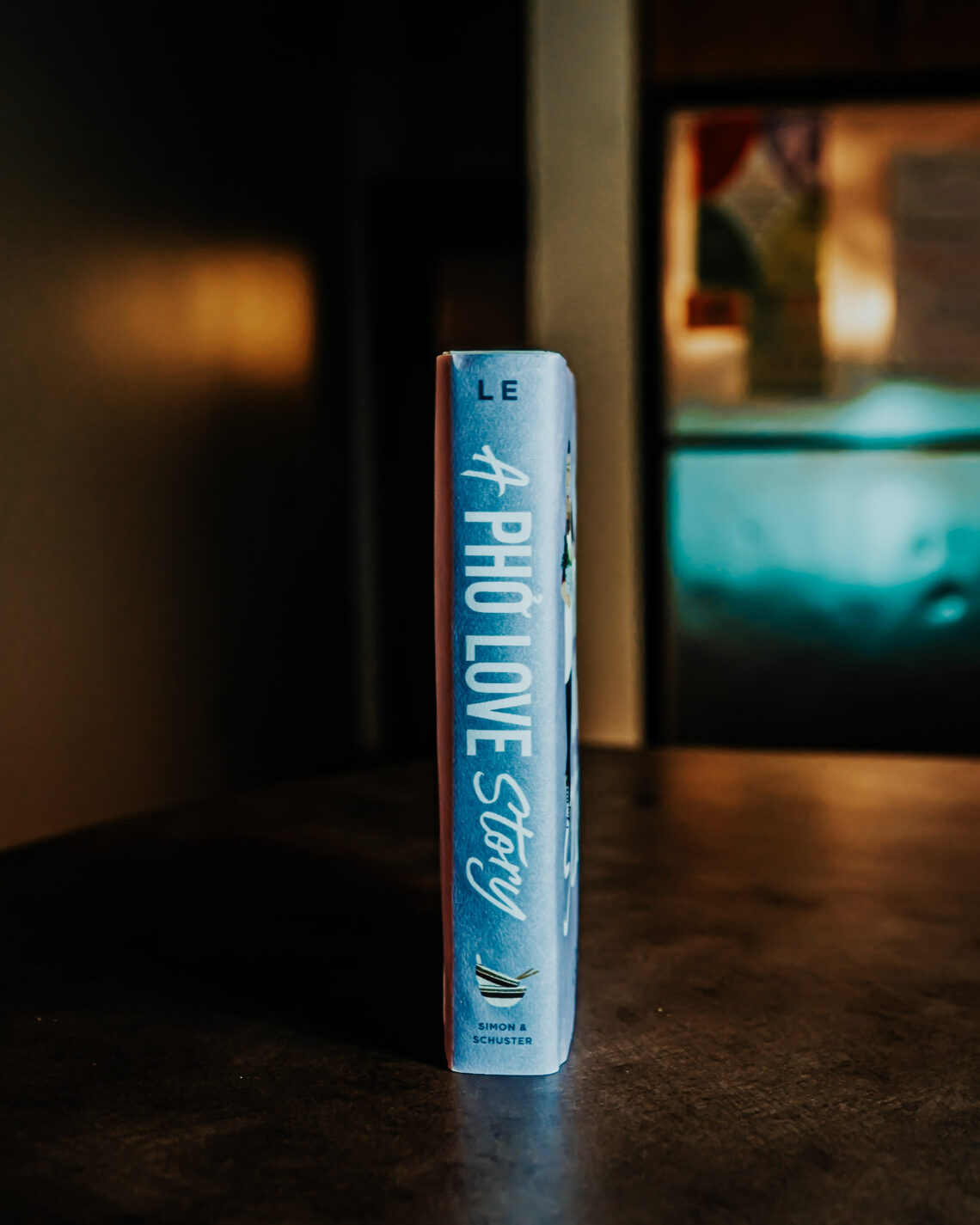
Photos Courtesy of Zamien Allard. The featured image is a shot of the spine of A Phở Love Story on a gray kitchen counter with the fridge in the background. The novel has a blue hue to it because of the lighting. The second photo in post is of the front of the novel, and the cover is lavender with the two main characters in aprons holding bowls of food.
Le, Loan. A Phở Love Story. Simon & Schuster BFYR, 2021.
[1] https://read.dukeupress.edu/meridians/article-abstract/8/2/1/138447/Manolos-Marriage-and-MantrasChick-Lit-Criticism

You May Also Like

To All the Boys I’ve Loved Before Book Review: Love Letters in the Teal Hatbox

